It’s a question worth asking honestly. In 2026, at a time when thermostats are controlled from a phone, interior blinds open automatically depending on the time of day, and home automation is making its way into every corner of the house, does a manual outdoor blind still have a place? The instinctive answer would be to say no, that motorized systems are inevitably superior, that manual operation is an outdated option reserved for tight budgets, and that everyone should choose a smart screen. But that answer would be too hasty, and, above all, inaccurate. The real answer is more nuanced, and it depends largely on who you are, how you use your outdoor space, and what you truly value in a product.
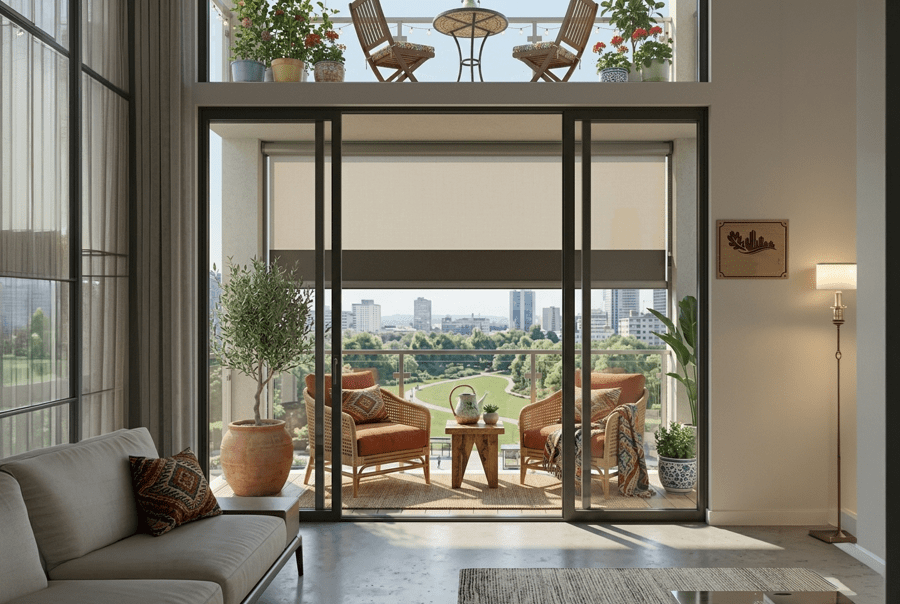
Let’s be honest: what the engine really delivers
Let’s start by acknowledging what motorization offers, because it really does offer something. Convenience, first of all: Opening or closing a motorized blind takes just a second using a remote control or a phone. No need to get up, no need to go near the mechanism, no need to interrupt what you’re doing. For people with limited mobility, for hard-to-reach areas, or simply for homeowners who want maximum comfort, motorization is a real and tangible benefit.
Frequency of use is also affected: A motorized screen is statistically used more often than a manual one, precisely because the barrier to use is virtually nonexistent. And in Quebec, where the weather changes rapidly, this responsiveness is truly valuable. Finally, motorization allows for integration into broader home automation systems, including scheduled programming, wind or rain sensors that automatically close the awning, and ambiance scenarios. For tech enthusiasts, this is an undeniable draw.
What the manufacturer doesn’t always tell you
But motorization also has its downsides, which are rarely mentioned in sales pitches. The first is complexity. A motorized blind is an electromechanical system with components that can fail: the motor, the wiring, the remote control, the radio receiver, and the control box. Each of these components represents a potential point of failure. A motor failure in the middle of summer can completely immobilize your screen and require the intervention of a technician, with the delays and associated costs.
The second drawback is technological obsolescence. Control systems evolve rapidly: A discontinued remote control, an abandoned communication protocol, an app that is no longer supported, and your “smart” blind from five years ago suddenly becomes less convenient to use. Manual screens, on the other hand, have no compatibility issues; the crank will work in 2026 exactly as it did in 2006, and will still work in 2036.
The third drawback is dependence on electricity. A motorized screen requires a power source: Either via a power cord or a rechargeable battery. In the event of a power outage, some models can be operated manually in emergency mode, but not all of them, and not always easily. For vacation homes or properties where the power supply may be intermittent, this is not a minor detail.
For whom is a manual blind still the best choice in 2026?
The real question isn’t “motorized or manual” in absolute terms; it’s “motorized or manual for you, in your situation.” And for a significant number of Quebec homeowners, the honest answer is still manual. Here’s why.
If you use your screen in a relatively consistent manner, unrolling it in the morning and rolling it up in the evening, without making multiple adjustments throughout the day, motorization doesn’t offer much practical benefit for your needs. The convenience of the remote control doesn’t necessarily justify the extra cost and added complexity if your usage is simple and predictable.
If you value absolute reliability over technological convenience, if the idea of a blind that always works, without exception, without breakdowns, without updates, and without battery replacements, appeals to you more than that of a smart blind, then a manual blind is the answer for you. A well-designed crank mechanism can last for decades without any special maintenance. No motor, no matter how good it is, can offer this guarantee of mechanical longevity.
If you value local production and technological simplicity, and if you prefer products that consume less energy, rely less on electricity, and have a smaller technological footprint, the crank-operated screen fits naturally into this philosophy. And finally, if you’re looking for the best value for money in a professional-grade screen made with high-end materials, without paying the premium for motorization, the manual model lets you invest more in what really matters: the fabric, the frame, and the finishes.
Mitico: Proof That “Manual” Doesn’t Mean “Inferior”
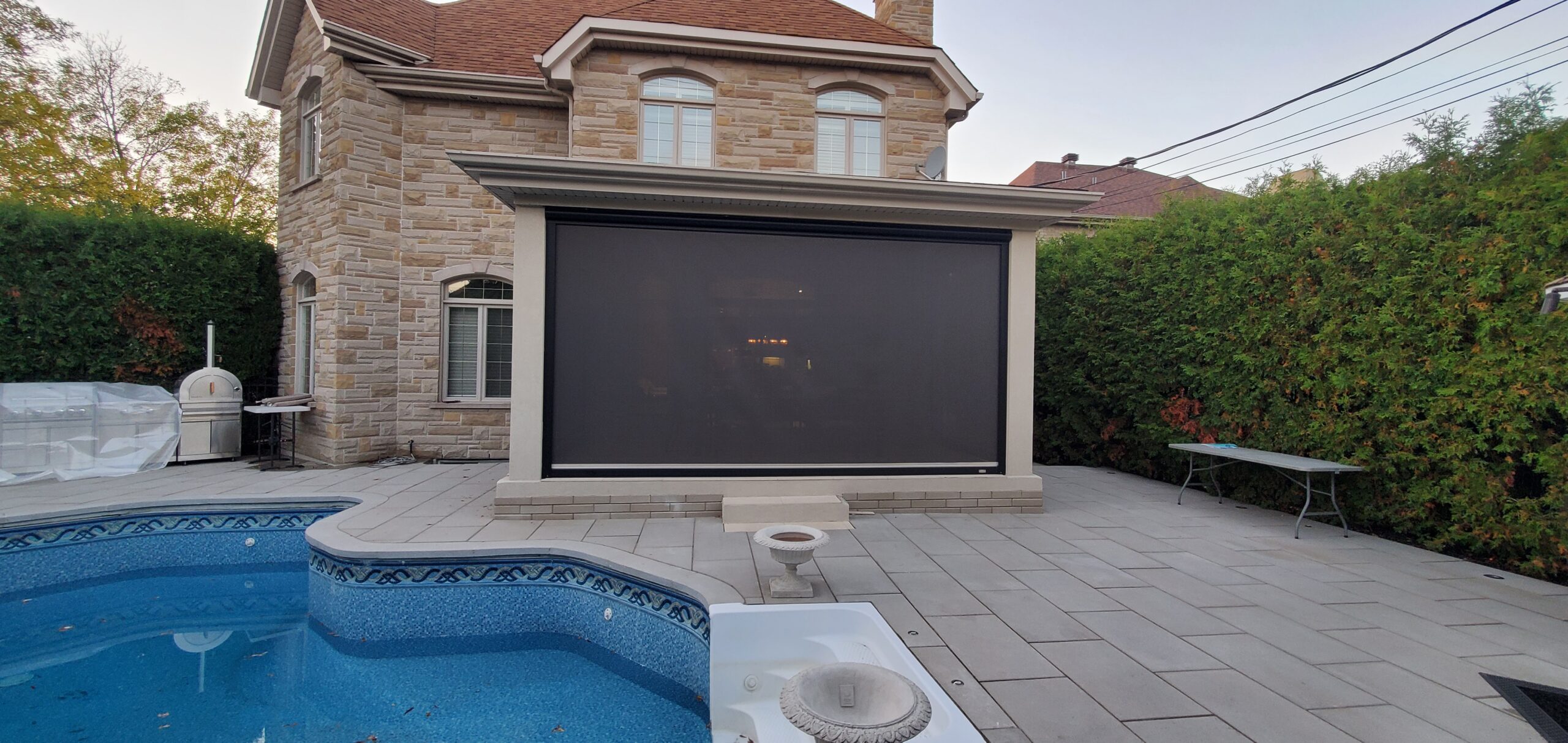
It is precisely to meet the needs of these types of buyers that Ombrasole’s Mitico crank-operated screen was designed, not as a cheap alternative to motorized models, but as a high-end product that fully embraces its manual nature. Designed and manufactured exclusively at Ombrasole’s Montreal factory, the Mitico exterior screen uses the same Serge Ferrari fabrics as the most sophisticated motorized products, fabrics recognized worldwide for their durability, UV resistance, and technical performance.
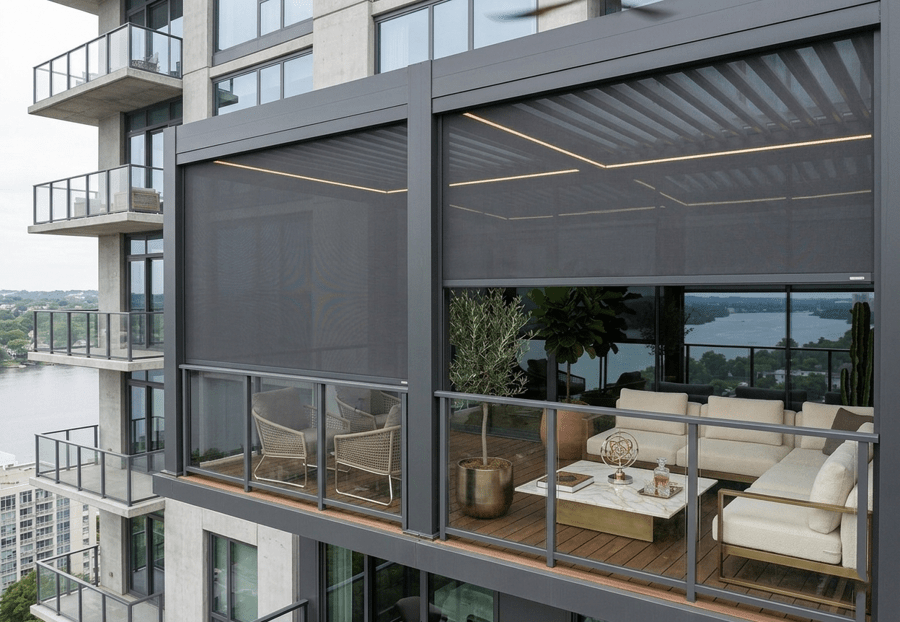
Its extruded aluminum frame, available in sophisticated black or light anodized gray, is built to the same high-quality standards as the entire Ombrasole line. And its revolutionary wind-resistant locking system, located at the bottom of the screen, is an innovation that most motorized retractable screens do not offer: It keeps the fabric perfectly stable even in strong winds, without zippers in the side guides, without flapping, and without billowing. This system permanently solves the most common problem with outdoor screens, the fabric opening and billowing in the wind, thanks to a simple and infinitely reliable mechanical solution.
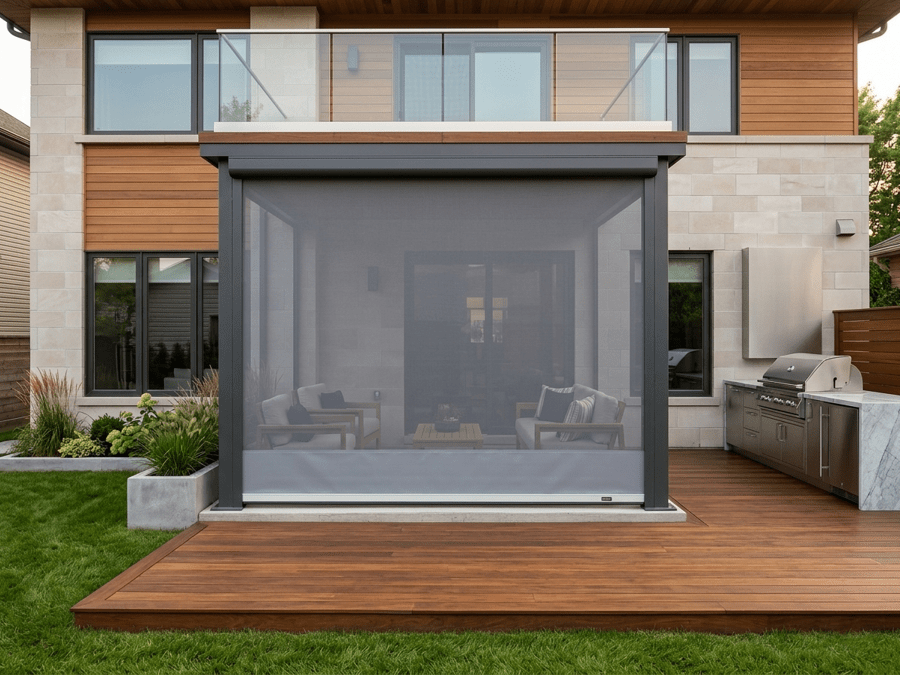
Custom-made, Mitico fits your balcony, terrace, or patio perfectly. And its crank mechanism, precisely because it’s simple, is also the most reliable: no electronic components, no technological points of failure, and no potential repair costs. It works today, and it will still be working in ten years, and in twenty years.
Manual or Motorized: How to Make the Right Choice for You
If you’re still on the fence, here are two simple questions to help you make up your mind. First question: Do you naturally adjust your environment several times a day, or do you prefer to set things up once and leave them be? If you’re the type to adjust the temperature, lights, and blinds based on the time of day and your mood, motorized controls will suit you better. If you’re the type to set up a configuration and stick with it, the manual option will be just as satisfying.
Second question: What causes you more anxiety, the thought of having to get up to adjust your screen, or the prospect of an electronic malfunction on a Saturday night in July when you have guests over? The answer to this question tells you a lot about what really suits you.
The best screen is the one that fits your lifestyle, not the one with the most features.
In 2026, the hand-cranked exterior screen is not an outdated option, it’s a different option, with its own distinctive advantages: Absolute reliability, mechanical durability, minimalist design, and unbeatable value for money. For homeowners who value these characteristics, it remains the best choice, provided they select a product that doesn’t sacrifice material quality in the name of a simple mechanism. Ombrasole’s Mitico crank-operated screen is exactly that, as demanding in terms of fabric quality, structure, and finishes as any motorized product in the line, but with the simplicity and reliability of a mechanism that doesn’t require technology to function perfectly.
MOST RECENT
Read our latest articles
All you need to know about custom made awnings, outdoor canopies maintenance, decoration and more.