The term “bioclimatic” is on everyone’s lips in the world of outdoor design—but what does it really mean? And more importantly, how does a bioclimatic pergola actually change the way you experience your outdoor space? If you’ve heard this term before but aren’t quite sure what sets a bioclimatic pergola apart from a regular one, this guide is for you. We’ll demystify the concept, explain how it works, and give you all the tools you need to figure out if it’s the right solution for your home—without unnecessary jargon or sales pitches.
Bioclimatic: What Does This Word Really Mean?
The term “bioclimatic” comes from the combination of “bio” (life, the natural environment) and “climatic” (climate, atmospheric conditions). In architecture and design, a bioclimatic design refers to an approach that intelligently uses natural elements—sunlight, wind, rain, and temperature—to create comfortable conditions, rather than simply enduring or fighting against them.
When applied to a pergola, the bioclimatic concept refers to a structure designed to actively regulate the environment it creates—by controlling the amount of sunlight that enters, air circulation, and protection from rain. Unlike a traditional pergola with a fixed roof, which always offers the same level of protection regardless of the conditions, a bioclimatic pergola adapts—it responds to changes in the weather and the user’s preferences.
From the traditional pergola to the bioclimatic pergola: a logical evolution
Pergolas have been around for millennia. Even in ancient Greece and Rome, people were already building lightweight structures to define outdoor spaces and provide some shade. Over the centuries, the pergola has evolved in terms of materials and aesthetics, from wood to wrought iron to aluminum, but its basic principle has remained the same: A fixed structure with a permanent roof, whether made of wood, polycarbonate, stretched fabric, or climbing plants.
The fundamental problem with a traditional pergola is its lack of flexibility. A fixed roof that provides good protection from the rain also blocks light and ventilation on sunny days. An open roof that lets in sunlight and air offers no protection when it rains. The bioclimatic pergola was born from this simple observation: What if we could have both, protection when we need it, and openness when we prefer it? That is exactly what the motorized adjustable louver system has made possible, transforming the pergola from a passive structure into an active, adaptive feature.
How does a bioclimatic pergola work?
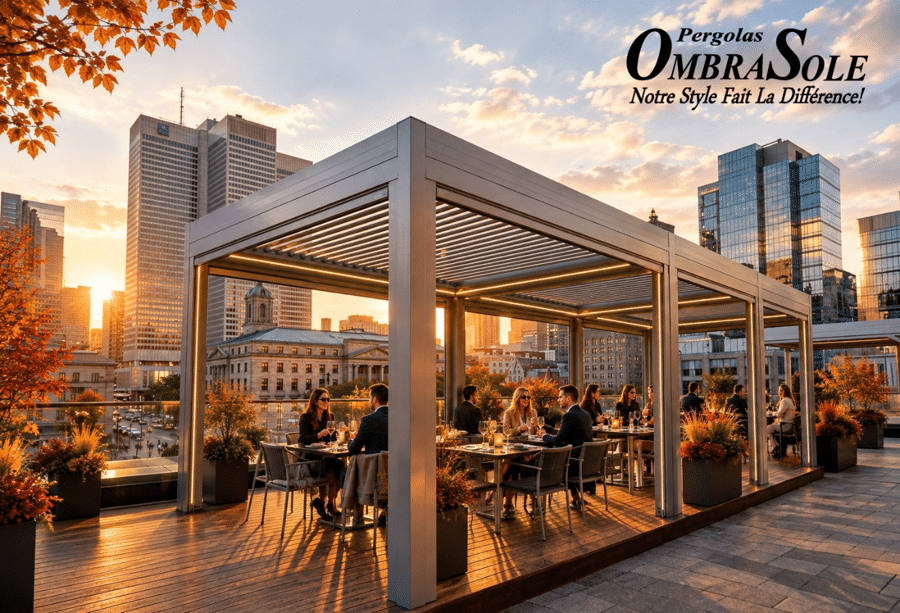
The heart of a bioclimatic pergola is its louvers, the horizontal elements that make up the roof and can pivot on their axis. Unlike the louvers of a wooden pergola, which are fixed, the louvers of a bioclimatic pergola are adjustable: They can move from a fully open position (louvers parallel to the vertical, allowing air and light to pass freely) to a fully closed position (Louvers interlocked with one another, forming a watertight roof). And between these two extremes, there are an infinite number of intermediate positions that allow you to precisely control the amount of light, shade, and ventilation.
In a motorized bioclimatic pergola, this movement is controlled by a motor—usually built into the structure so it remains hidden—that responds to a remote control or a smartphone app. The louvers’ angle can be adjusted effortlessly in just a few seconds from anywhere in your space. And when the slats are in the closed position, the gutter system built into the structure, often concealed within the louvers themselves and the posts—collects rainwater and drains it discreetly, keeping the space below perfectly dry.
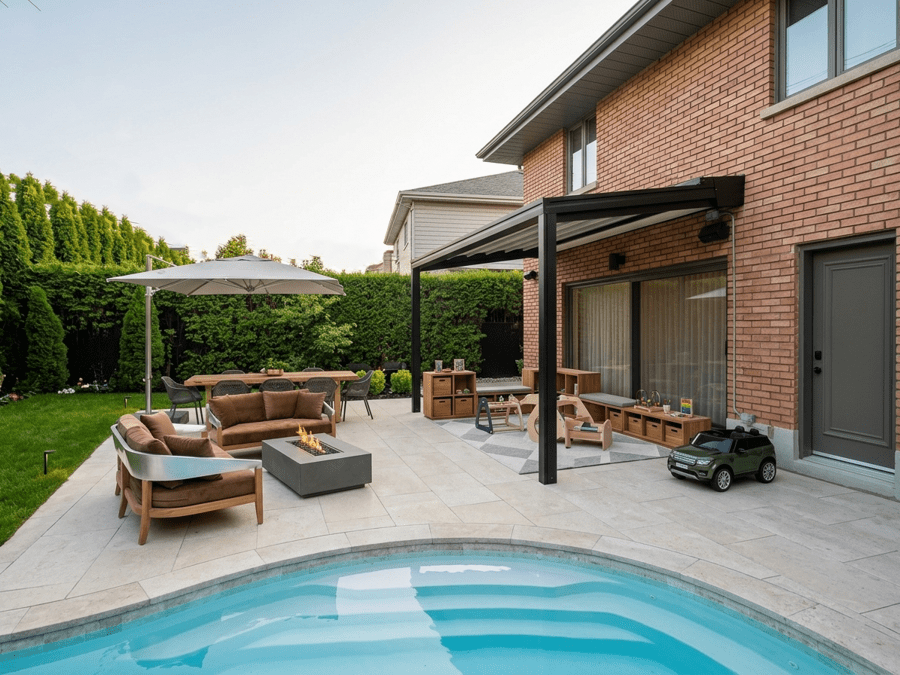
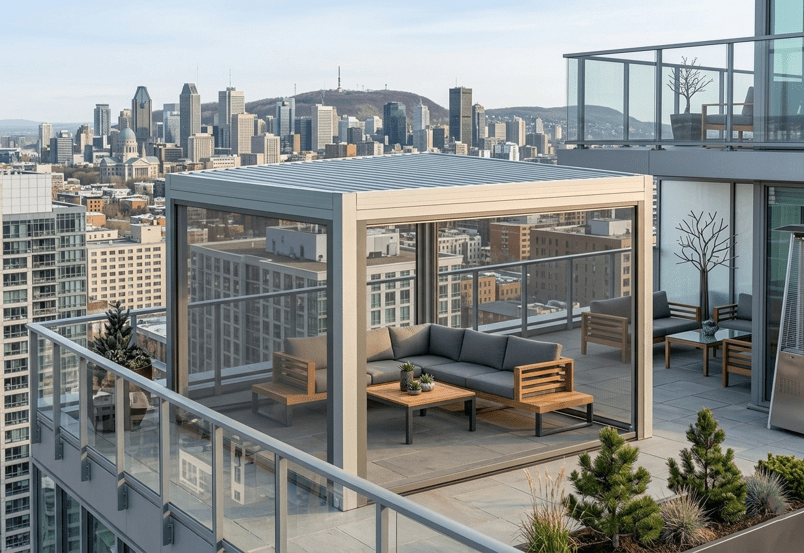
The structure itself is generally freestanding, that is, it stands on its own thanks to its posts, without needing to be anchored to the house’s exterior. This offers great flexibility in installation and allows you to position the pergola exactly where you need it, regardless of your building’s architecture.
The Practical Benefits of a Bioclimatic Pergola
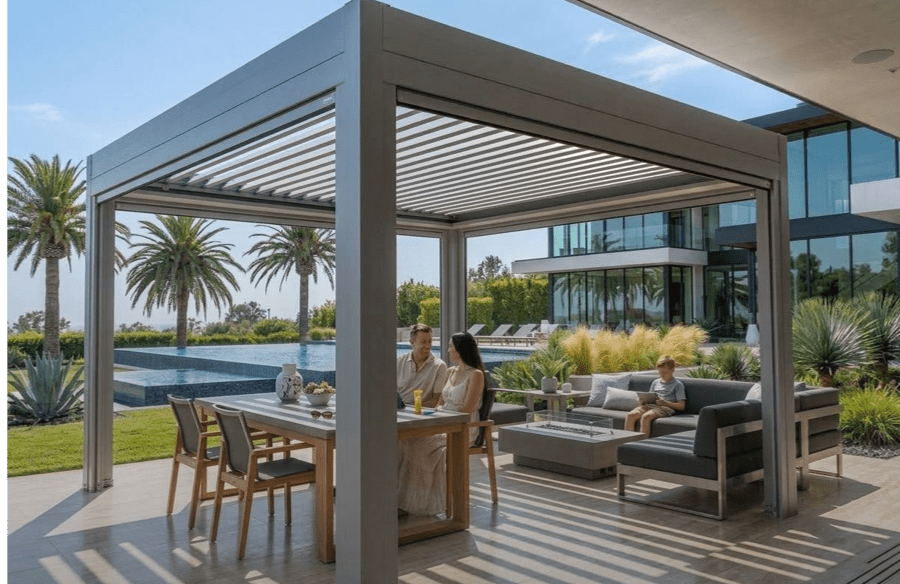
A well-designed bioclimatic pergola radically transforms the way an outdoor space is used. The first advantage is year-round use: whereas a standard pergola is really only useful in warm, sunny weather, a bioclimatic pergola allows you to enjoy your outdoor space in the rain, in bright sunshine, in the wind, and even, on cool fall evenings. In Quebec, this can extend the outdoor season by several weeks on either side of summer.
The second benefit is precise control over your environment. You can create exactly the atmosphere you want: Soft lighting for a relaxing evening, maximum ventilation on hot days, and complete protection from a sudden downpour. This control no longer depends on the weather, it depends on you.
The third benefit is the added value it brings to the property. A bioclimatic pergola is a visible and valuable investment. It transforms the appearance of an outdoor space, increases the perceived living area of the property, and serves as a concrete, unique selling point in a competitive real estate market.
What to Check Before Buying a Bioclimatic Pergola
Not all bioclimatic pergolas are created equal, and certain criteria are particularly important for ensuring a sustainable and satisfying investment. The first criterion is the quality of the slats and the structure. Anodized extruded aluminum louvers are the gold standard: Sturdy, corrosion-resistant, lightweight, and durable. Be wary of thin-walled aluminum frames or slats made of composite materials of questionable quality, they won’t hold up well against Quebec’s harsh weather conditions.
The second criterion is motor reliability. In a motorized bioclimatic pergola, the motor is the central component of the system. Somfy is the global leader in motorization for this type of equipment—recognized for its reliability, durability, and after-sales service network. A pergola equipped with a Somfy motor offers concrete guarantees of longevity and ease of maintenance.
The third criterion is customization. A bioclimatic pergola must adapt perfectly to your space—not the other way around. The dimensions, colors, finishes, and options must be customizable to create a result that blends seamlessly with your home’s architecture. And finally, warranties: a substantial warranty on the structure and the motor reflects the manufacturer’s confidence in the durability of its product.
The Eolo Star: The Bioclimatic Pergola Designed for Quebec
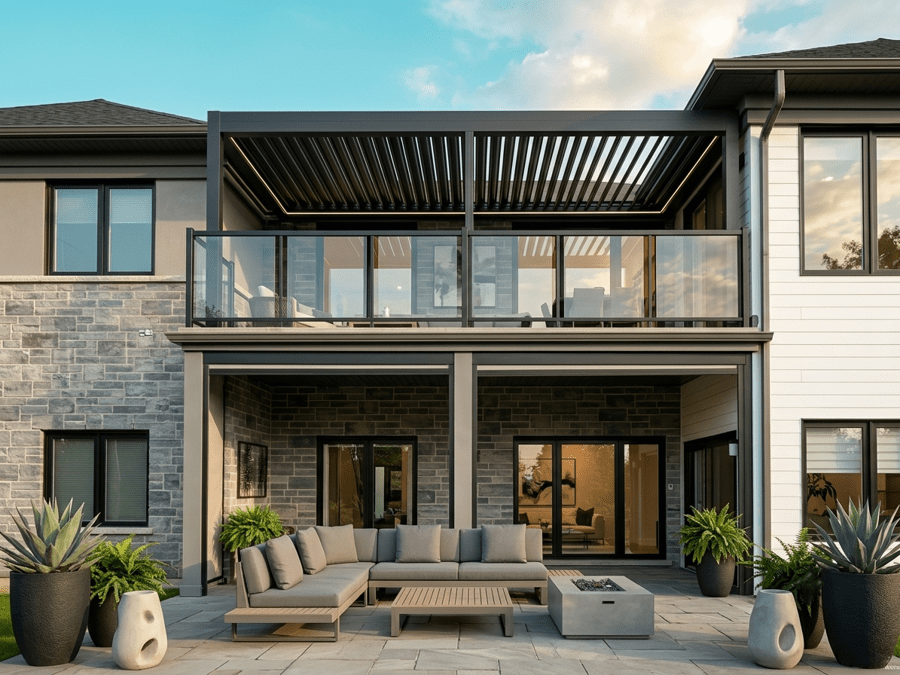
With all these criteria in mind, Ombrasole’s Eolo Star bioclimatic pergola stands out as the benchmark in the Quebec market. Designed and manufactured in Quebec for our specific climate, the Eolo Star combines all the elements of a top-tier bioclimatic pergola. Its motorized, adjustable louvers, made of extruded aluminum, can be adjusted up to 160 degrees using a Somfy motor) via a simple remote control. Its self-supporting extruded aluminum frame, available in black or light gray, is backed by a 15-year warranty.
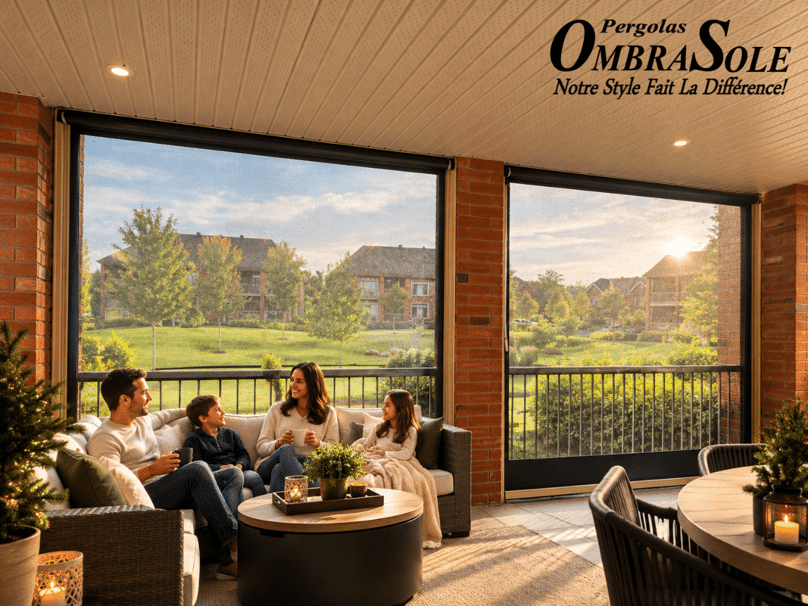
What really sets the Eolo Star apart is the range of options tailored to the Quebec context: A roof-mounted mosquito net (a first in North America), side mosquito nets, motorized wind-resistant curtains, and LED lighting to extend the season into October. Custom-built, modular for large areas, and featuring an integrated gutter system that drains water through the posts, the Eolo Star is the comprehensive, Quebec-based answer to the question, “What should a bioclimatic pergola offer?”
A bioclimatic pergola isn’t a luxury, it’s the smart solution for our climate
A bioclimatic pergola is, at its core, a decision to take back control of your outdoor space—to no longer depend on the whims of the weather to decide when and how you enjoy your patio. Here in Quebec, where the outdoor season is short and precious, this ability to control the weather isn’t a luxury, it’s a smart way to make the most of every moment of good weather we’re given, and to create new ones when the weather isn’t so cooperative.
MOST RECENT
Read our latest articles
All you need to know about custom made awnings, outdoor canopies maintenance, decoration and more.